
The Sun's gravitational pull keeps the planets and other objects in the solar system in orbit around it.
The first and closest planet to the sun. It circles the sun faster than all the other planets, which is why Romans named it after their swift-footed messenger god.
Named for the Roman goddess of love and beauty is the second planet after sun. In ancient times, Venus was often thought to be two different stars, the evening star and the morning star.
Earth,the third planet and our home. It is the only planet known to have an atmosphere containing free oxygen, oceans of liquid water on its surface, and, of course, life.
Fourth planet from the Sun and the second smallest planet in the solar systm. Named after the Roman god of war often described as the “Red Planet”.

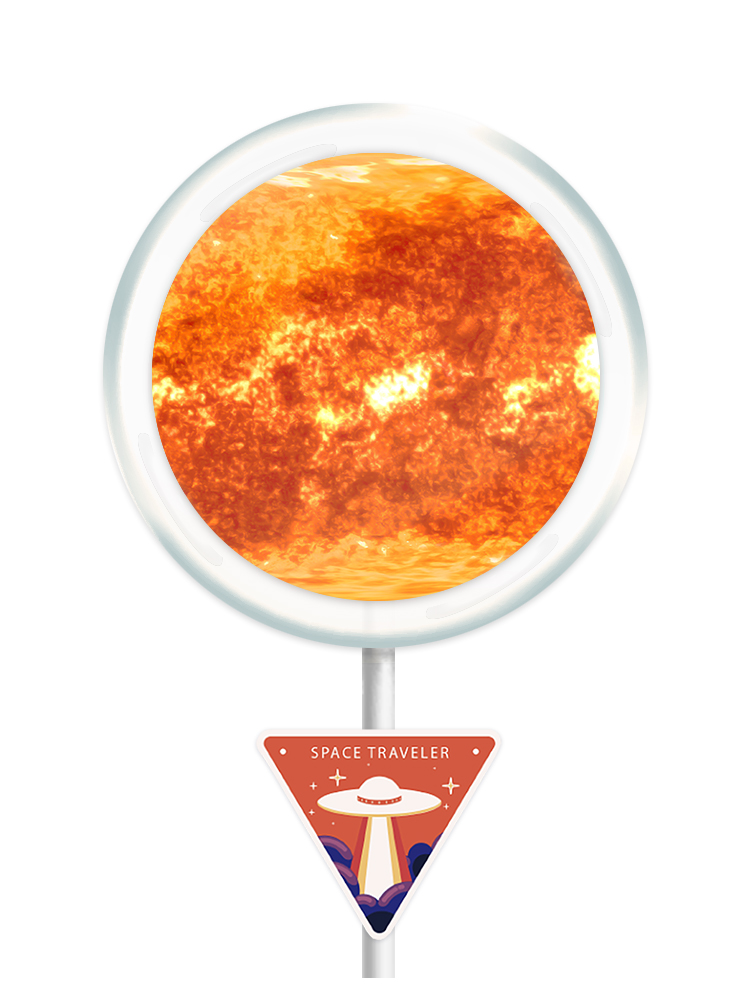
The Sun is a magnificent and crucial star at the center of our solar system. As a nearly perfect sphere of hot plasma, it plays a vital role in sustaining life on Earth and maintaining the balance of our planetary system. Classified as a yellow dwarf, or G-type main-sequence star, the Sun is about 4.6 billion years old.
The Sun's energy is generated through nuclear fusion reactions in its core, where hydrogen atoms fuse to form helium, releasing immense amounts of energy in the process. This energy is emitted as sunlight and other forms of electromagnetic radiation. The Sun's gravitational pull keeps the planets and other objects in the solar system in orbit around it. It is the dominant source of light and heat for Earth and plays a crucial role in sustaining life on our planet. Studying the Sun helps scientists understand fundamental processes in astrophysics, such as stellar evolution, solar activity cycles (like sunspots and solar flares), and the dynamics of planetary atmospheres influenced by solar radiation.
1. Core: The innermost part where nuclear fusion occurs, producing the Sun's energy.
2. Radiative Zone: Surrounding the core, this layer transfers energy outward through radiation.
3. Convective Zone: The outer layer where energy is transferred by convection currents.
4. Photosphere: The visible surface of the Sun, from which sunlight is emitted.
5. Chromosphere: Located above the photosphere, this layer is visible during solar eclipses.
6. Corona: The outermost layer, extending millions of kilometers into space and forming a white halo visible during total solar eclipses.
Energy production in the Sun occurs through nuclear fusion, where hydrogen nuclei combine to form helium, releasing vast amounts of energy in the process. This energy is radiated out from the Sun in the form of electromagnetic radiation, including visible light, ultraviolet light, and infrared radiation.
The Sun's activity includes various phenomena such as sunspots, solar flares, and coronal mass ejections (CMEs). Sunspots are dark, cooler areas on the Sun's surface caused by magnetic activity. Solar flares are intense bursts of radiation and energy, often linked to sunspots. CMEs involve the expulsion of large amounts of plasma and magnetic fields from the Sun's corona, which can impact space weather and communication systems on Earth.
The Sun is essential for life on Earth, providing the light and heat necessary for photosynthesis in plants and regulating the planet's climate. The tilt of Earth's axis and its orbit around the Sun result in seasonal changes and influence climate patterns. Additionally, the solar wind, a stream of charged particles from the Sun's corona, interacts with Earth's magnetic field, creating phenomena like the auroras.
Currently in its main-sequence phase, the Sun will eventually exhaust its hydrogen fuel in about 5 billion years. It will then expand into a red giant, shed its outer layers to form a planetary nebula, and finally shrink into a dense white dwarf.
In summary, the Sun is a dynamic and vital star that governs the solar system, providing energy, regulating climate, and enabling life on Earth. Its complex structure and varied activities make it a fascinating subject of study and an indispensable part of our cosmic environment.

size
1.4 Million km

MOONS
No Moons

LENGTH OF YEAR
0 Days

LENGTH OF DAY
600 - 800 Hours

TEMPERATURE C/F
5,500 °C / 9,932 °F

DISTANCE FROM SUN
0 km

ATMOSPHERE
hydrogen (about 74%), helium (about 24%)
The Sumerians also knew of Mercury since at least 5,000 years ago. It was often associated with Nabu, the god of writing. Mercury was also given separate names for its appearance as both a morning star and as an evening star. Greek astronomers knew, however, that the two names referred to the same body, and Heraclitus, around 500 B.C., correctly thought that both Mercury and Venus orbited the sun, not Earth.
Mercury, being the closest planet to the Sun, has extreme temperature variations between day and night. Its lack of a significant atmosphere contributes to these drastic changes and means the planet cannot retain heat. The absence of moons and its slow rotation result in lengthy days and nights.
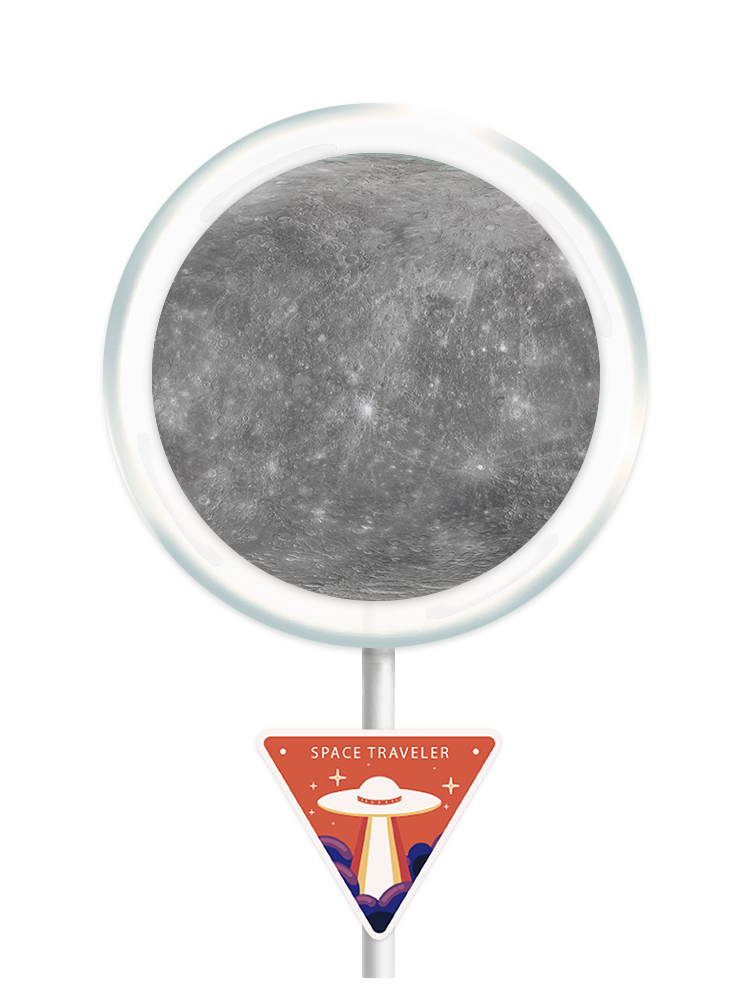
One of five planets visible with the naked eye a, Mercury is just 4,879 Kilometers across its equator, compared with 12,742 Kilometer for the Earth.
Even though the planet is small, Mercury is very dense. Each cubic centimeter has a density of 5.4 grams, with only the Earth having a higher density. This is largely due to Mercury being composed mainly of heavy metals and rock.
As the iron core of the planet cooled and contracted, the surface of the planet became wrinkled. Scientist have named these wrinkles, Lobate Scarps. These Scarps can be up to a mile high and hundreds of miles long.
size
4,880 km
MOONS
No Moons
LENGTH OF YEAR
88 Earth Days
LENGTH OF DAY
4224 Hours
TEMPERATURE C/F
430 °C / 800 °F
DISTANCE FROM SUN
57.9 Million km
ATMOSPHERE
oxygen, sodium, hydrogen, helium, and potassium
The planet — the only planet named after a female — may have been named for the most beautiful deity of her pantheon because it shone the brightest of the five planets known to ancient astronomers.In ancient times, Venus was often thought to be two different stars, the evening star and the morning star — that is, the ones that first appeared at sunset and sunrise. In Latin, they were respectively known as Vesper and Lucifer. In Christian times, Lucifer, or "light-bringer," became known as the name of Satan before his fall. However, further observations of Venus in the space age show a very hellish environment. This makes Venus a very difficult planet to observe from up close, because spacecraft do not survive long on its surface.
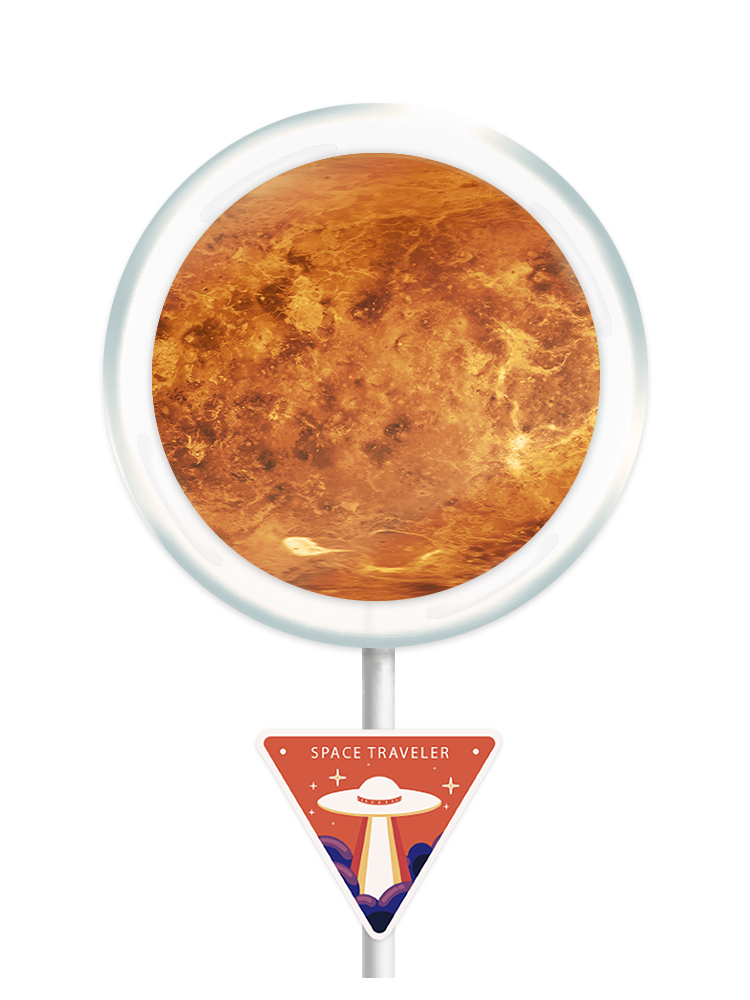
It takes 243 Earth days to rotate once on its axis (sidereal day). The planet’s orbit around the Sun takes 225 Earth days, compared to the Earth’s 365. A day on the surface of Venus (solar day) takes 117 Earth days.
This means that Venus is rotating in the opposite direction to the Sun, this is also known as a retrograde rotation. A possible reason might be a collision in the past with an asteroid or other object that caused the planet to alter its rotational path. It also differs from most other planets in our solar system by having no natural satellites.
Only the Moon is brighter. With a magnitude of between -3.8 to -4.6 Venus is so bright it can be seen during daytime on a clear day.
While its size and mass are similar to Earth, the small asteroids are crushed when entering its atmosphere, meaning no small craters lie on the surface of the planet. The pressure felt by a human on the surface would be equivalent to that experienced deep beneath the sea on Earth.
size
12,104 km
MOONS
No Moons
LENGTH OF YEAR
225 Earth Days
LENGTH OF DAY
2808 Hours
TEMPERATURE C/F
465 °C / 869 °F
DISTANCE FROM SUN
108.2 Million km
ATMOSPHERE
carbon dioxide (96.5%) and nitrogen (3.5%),with clouds of sulfuric acid.
Earth is the fifth largest of the planets in the solar system — smaller than the four gas giants, Jupiter, Saturn, Uranus and Neptune, but larger than the three other rocky planets.Earth is the third planet from the Sun and the only known planet to support life. It has a diverse climate and weather system, liquid water, and a breathable atmosphere. Earth's atmosphere protects life by blocking harmful solar radiation, reducing temperature extremes between day and night, and containing the oxygen necessary for life. The presence of a large, natural satellite, the Moon, affects Earth's tides and stabilizes its axial tilt, contributing to a stable climate.
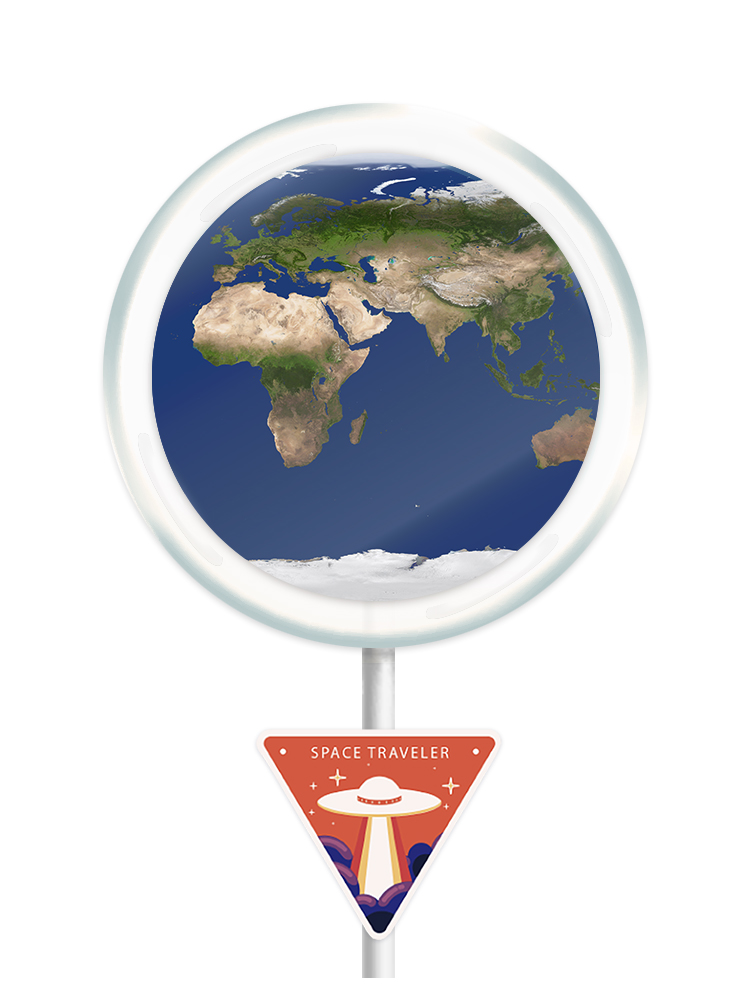
This deceleration is happening almost imperceptibly, at approximately 17 milliseconds per hundred years, although the rate at which it occurs is not perfectly uniform. This has the effect of lengthening our days, but it happens so slowly that it could be as much as 140 million years before the length of a day will have increased to 25 hours.
Due to the apparent movements of the Sun and planets in relation to their viewpoint, ancient scientists insisted that the Earth remained static, whilst other celestial bodies travelled in circular orbits around it. Eventually, the view that the Sun was at the center of the universe was postulated by Copernicus, though this is also not the case.
This phenomenon is caused by the nickel-iron core of the planet, coupled with its rapid rotation. This field protects the Earth from the effects of solar wind.
As a percentage of the size of the body it orbits, the Moon is the largest satellite of any planet in our solar systm. In real terms, however, it is only the fifth largest natural satellite.
size
12,742 km
MOONS
The Moon
LENGTH OF YEAR
365 Days
LENGTH OF DAY
24 Hours
TEMPERATURE C/F
Average 15 °C / 59 °F
DISTANCE FROM SUN
149.6 Million km
ATMOSPHERE
nitrogen (78%),oxygen (21%), argon (1%),and trace amounts of other gases including carbon dioxide and water vapor.
Mars, known as the Red Planet due to its reddish appearance caused by iron oxide (rust) on its surface, is the fourth planet from the Sun. It has the largest volcano in the solar system, Olympus Mons, and a canyon system, Valles Marineris, that dwarfs the Grand Canyon. Mars has polar ice caps that grow and recede with the changing seasons. Its thin atmosphere means it cannot retain heat, resulting in significant temperature fluctuations. The presence of ancient riverbeds and minerals that form in water suggests that Mars once had liquid water on its surface, raising the possibility that it could have supported life in the past.
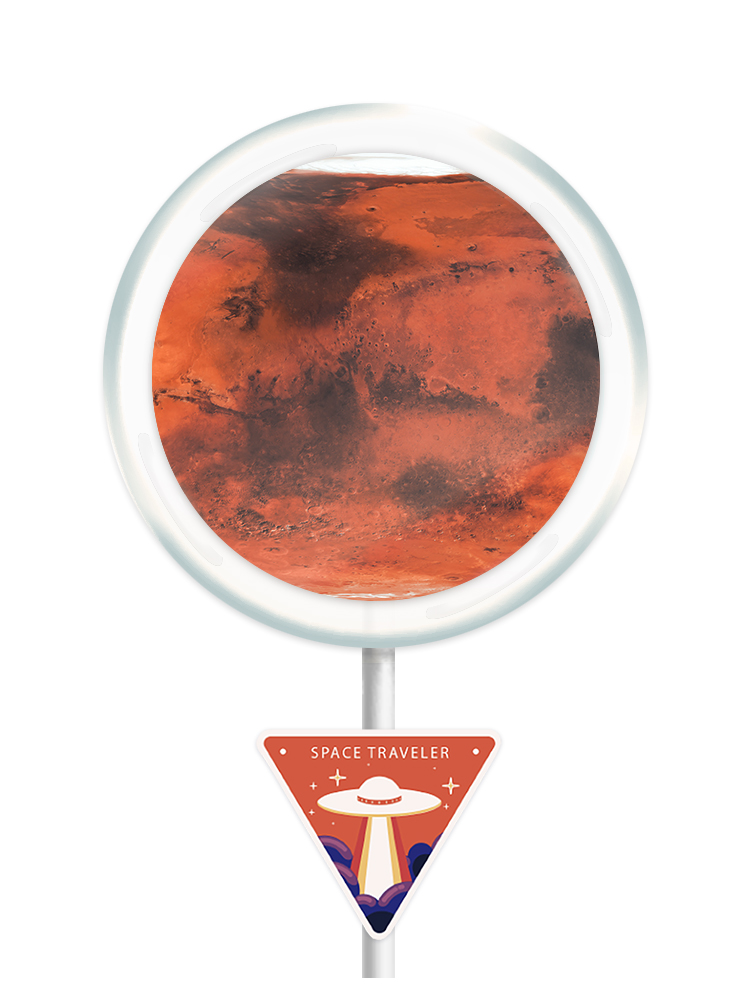
Even though Mars has only 15% of the Earth’s volume and just over 10% of the Earth’s mass, around two thirds of the Earth’s surface is covered in water. Martian surface gravity is only 37% of the Earth’s (meaning you could leap nearly three times higher on Mars).
Olympus Mons, a shield volcano, is 21km high and 600km in diameter. Despite having formed over billions of years, evidence from volcanic lava flows is so recent many scientists believe it could still be active.
As of September 2014, there have been 40 missions to Mars, including orbiters, landers and rovers but not counting flybys. The most recent arrivals include the Mars Curiosity mission in 2012, the MAVEN mission, which arrived on September 22, 2014, followed by the Indian Space Research Organization’s MOM Mangalyaan orbiter, which arrived on September 24, 2014. The next missions to arrive will be the European Space Agency’s ExoMars mission, comprising an orbiter, lander, and a rover, followed by NASA’s Insight robotic lander mission, slated for launch in March 2016 and a planned arrival in September, 2016.
They can last for months and cover the entire planet. The seasons are extreme because its elliptical (oval-shaped) orbital path around the Sun is more elongated than most other planets in the solar system.
size
6,779 km
MOONS
Phobos and Deimos
LENGTH OF YEAR
687 Earth Days
LENGTH OF DAY
24.6 Hours
TEMPERATURE C/F
-63 °C / -81 °F
DISTANCE FROM SUN
227.9 Million km
ATMOSPHERE
carbon dioxide (95.3%), nitrogen (2.7%), argon (1.6%), and trace amounts of oxygen and water vapor.